
From Barely Being Found to a Brand People Recognize: A Local Business Growth Case Study
What happens when the quality of your work has outgrown the quality of your brand and online presence? For one growing Central Indiana service business, the answer wasn’t simply a new website. It was building a stronger foundation for the business they were becoming.
There is an awkward stage that a lot of small businesses eventually reach.
The work is good. Customers are happy. Referrals are happening. The business is gaining momentum through relationships and word of mouth. But when someone looks the company up online, what they find doesn’t quite match the business they’ve heard about.
That was the situation facing one local service company when we began working together.
They weren’t starting from nothing. They had a logo. They had a website. They had completed projects they were proud of and a small team capable of doing excellent work.
Technically, the pieces existed.
Strategically, they didn’t work together yet.
And perhaps most importantly, the goal wasn’t to suddenly flood a three-person team with more leads than they could handle. The goal was to develop a recognizable brand, create a stronger digital presence and establish the kind of marketing foundation that could grow alongside the business.
That distinction shaped nearly every decision that followed.
The Problem Wasn't That They Didn't Have a Brand. It Was That the Brand Didn't Say Much.
This is incredibly common, especially for newer service, construction and trade businesses.
When you’re starting a company, there are approximately 900 things that feel more urgent than developing a complete visual identity. A logo gets created. Black and white feels safe. Someone makes a business card. A Facebook page gets started. Shirts get ordered. Everyone gets back to work.
There’s nothing inherently wrong with starting there.
The problem comes later, when the business begins growing but the branding doesn’t grow with it.
In this case, the original logo was simple, one-color and fairly two-dimensional. There wasn’t an established brand guide defining colors, typography, photography, supporting graphics or how everything should work together. That meant the company could look slightly different depending on where a customer encountered it.
A social media graphic might have one look. A shirt might have another. The website might introduce something completely different.
None of those things individually make a business unsuccessful, but together they make it much harder to become recognizable.
Through Plaski’s broader brand and marketing strategy services, we developed an identity that gave the company more personality without losing the straightforward, professional feel that made sense for its industry.
The result wasn’t simply a prettier logo.
It created a visual system.
Colors had a purpose. Fonts were established. Supporting graphics could be created consistently. Photography had a clearer direction. Future marketing pieces had something to build from instead of starting over every time.
And once that foundation existed, it could extend well beyond a computer screen.
The updated brand eventually appeared across company vehicles, sponsorship materials, social media, print pieces and other places customers encountered the business in the real world.
That’s when branding begins doing what it’s actually supposed to do: helping someone see your company once, encounter it somewhere else later and think, “I’ve seen them before.”
A Better Brand Still Needed Somewhere to Live
At the same time, there was another issue.
The company already had a website.
It worked.
And that’s an important distinction, because businesses don’t always come to us with a completely broken website. Sometimes it loads perfectly fine. The phone number works. There are a few pictures. It technically checks the “we have a website” box.
But having a website and having a website that contributes to your business are two very different things.
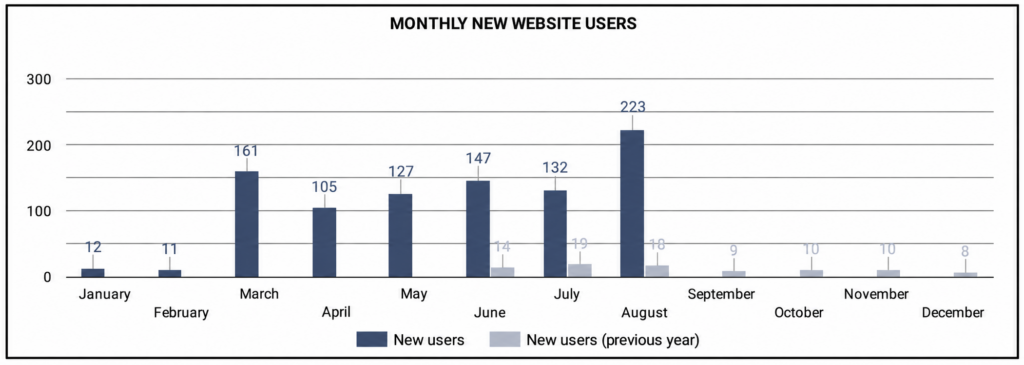
Before this project, the existing GoDaddy site was attracting very little traffic. The company’s analytics show just 18 website users in January 2026 and 16 in February.
Then the new brand and website launched in March.
That month, website users increased to 163.
That’s more than a 900% increase from February to March.
That is an impressive number, but it needs context.
We don’t claim that changing the website design alone magically created a 900% traffic increase. The branding changed. The website changed. The company’s digital presence was becoming stronger. Its portfolio was growing. Search engines had better information to work with. More people were encountering the company elsewhere.
Marketing rarely fits neatly into one attribution box.
What the graph does show is a very clear change in the company’s online baseline.
Google Doesn't Rank a Business Just Because a Website Exists
Those early numbers naturally led to questions we hear from business owners all the time:
Why aren’t we showing up on Google?
Why do competitors appear when I search for our services, but we don’t?
If we already have a website, why isn’t anyone finding it?
Those are fair questions.
The answer usually isn’t one magic setting hidden somewhere in the website.
A website is one piece of a much larger digital footprint.
This particular company was also young. It had only been operating for roughly a year, which meant it was competing online against businesses that may have spent years building websites, collecting reviews, earning links, publishing content and establishing geographic relevance.
Google simply didn’t have the same history or volume of signals to work with yet.
That doesn’t mean a newer business can’t compete. It means we need to make it easier for search engines to understand who the company is, what it does, where it works and why it may be a good answer for a particular search.
That’s why the new Website Development strategy wasn’t limited to making the website look better. Plaski’s website work is built around user experience, search visibility and helping visitors confidently take the next step.
For this business, that meant stronger service content, better website structure, intentional calls to action, local relevance, technical improvements and a much stronger showcase of completed work.
Because when you’re selling a highly visual service, your work should be doing some of the selling for you.
A potential customer shouldn’t have to imagine what you’re capable of.
They should be able to see it.
And Then the New Baseline Kept Growing
March could have been dismissed as a launch spike if traffic immediately disappeared. It didn’t.
The website went from 163 users in March to 115 in April, 136 in May, 153 in June, 139 in July and then 227 users in August. New users followed a similar pattern, reaching 223 in August.
August alone generated 306 website sessions, up 39.7% compared with the comparison period in the report.
That month’s traffic wasn’t coming from one source, either.
Google accounted for 50 website users with a 48.86% engagement rate, while Facebook and other referral sources contributed additional traffic. The homepage received 139 users, the locally focused garage-floor service page attracted 35, the cost-focused educational article attracted 28 and the Contact page received 29 users with an 88.89% engagement rate.
That last piece matters.
SEO isn’t valuable because a chart gets taller.
It’s valuable when someone finds an answer, learns about the company and moves closer to becoming a customer.
The Content Started Doing More Than Filling Pages
One reason the website needed more than a visual facelift was that service businesses increasingly need useful information behind the design.
Someone researching a home project may not begin by searching for your company name.
They may search:
How much does this cost?
Which product is better?
How long will the project take?
Who installs this near me?
Can this be used in my garage, basement or patio?
Those searches create opportunities.
Through ongoing Search Engine Optimization, we could continue building around the questions actual customers were asking rather than treating SEO as something finished the day the website went live. Plaski’s current SEO approach similarly treats search visibility as a long-term strategy involving website structure, customer search language, markets served and the surrounding competitive landscape.
By August, the results were beginning to show in the pages people were actually using.
A locally focused service page brought in 35 users during the month.
A cost article brought in 28.
Those aren’t viral-content numbers.
That’s not the goal.
For a local three-person service company, 28 people reading about the cost of the exact service you sell can be far more valuable than thousands of unrelated visitors.
What Did People Do Once They Found the Website?
This is where your Microsoft Clarity screenshot becomes very helpful.
Traditional analytics tells us that people arrived.
Behavior analytics helps us understand what happened next.
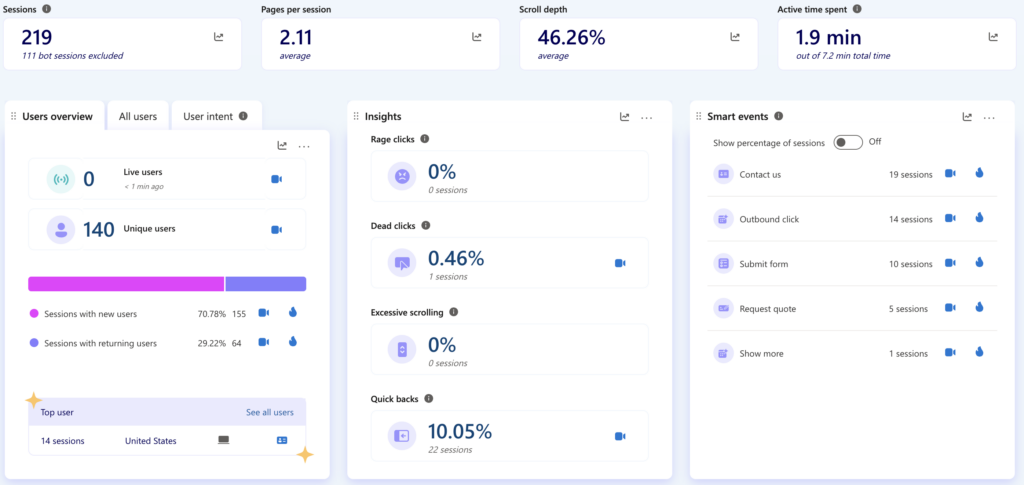
During the latest 30-day period shown in your Clarity dashboard, the website recorded 214 sessions from 138 unique users, averaging 2.10 pages per session and approximately 1.9 minutes of active time.
Clarity also tracked:
- 19 Contact Us interactions
- 13 outbound-click interactions
- 9 Submit Form interactions
- 3 Request Quote interactions
Those numbers should not be added together and presented as 44 leads. One visitor can complete several actions during the same visit.
What they do demonstrate is that visitors weren’t simply landing on the site and disappearing. People were exploring the website and interacting with paths designed to move them toward contacting the business.
The Goal Wasn't "More Leads at Any Cost"
This is where the strategy becomes a little different from the typical marketing case study.
We weren’t working with a company trying to feed a 30-person sales department.
There were three people.
That’s important.
Marketing is often presented as a race to generate the highest possible number of leads. But more isn’t automatically better if the company doesn’t have the staffing, scheduling capacity or operational systems to fulfill dramatically increased demand.
Generating 100 leads sounds impressive until 80 potential customers are frustrated because you can’t get to their project for six months.
So we intentionally approached growth differently.
The strategy needed to create momentum without creating chaos.
We had to consider:
- How much work could the team realistically complete?
- Which services were most valuable to grow?
- Where did the company want to work?
- How quickly did the owners actually want to expand?
- Which marketing investments made sense now?
- Which could wait?
That’s also why this case study connects naturally with Plaski’s work throughout Johnson County, including Franklin, Greenwood, Bargersville, Trafalgar and surrounding communities. Local marketing isn’t simply about putting a city name on a page. It requires understanding the actual service area, competition and realistic growth goals of the business.
Sometimes good marketing means pressing the accelerator.
Sometimes it means building the road first.
Social Media Became Another Place for the Brand to Be Recognized
The website wasn’t operating in isolation.
Neither was the brand.
Plaski began managing the company’s Facebook presence before the website launch, giving the business another place to consistently show completed projects, stay visible and reinforce the visual identity customers were beginning to recognize.
By February 2026, Facebook content recorded 4,819 viewers. March reached 5,374. June reached 5,148. Then July climbed to 10,626 viewers, followed by 7,916 in August.
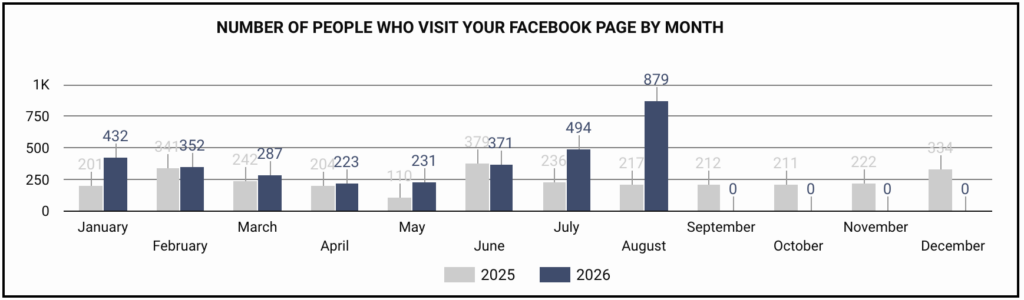
Facebook page visits also increased substantially through the summer, moving from 223 in April to 371 in June, 494 in July and 879 in August.
There is an important caveat here: Facebook page-like advertising began in July, so we would not claim that all of that later social growth was purely organic. The paid campaign itself generated 3,557 impressions and 202 clicks in July, followed by 5,689 impressions and 208 clicks in August.
That’s exactly why good reporting matters.
The job isn’t to grab the biggest number and take credit for it.
It’s to understand where the number came from.
Plaski’s Social Media Marketing services are built around that same idea: social should reinforce the brand, educate the audience and build trust instead of becoming a calendar full of random posts.
And because real project imagery played such an important role for this company, this is also a natural place to internally connect readers to Plaski’s Video and Photography services. For visual service businesses, photography isn’t decoration. It helps demonstrate the quality a potential customer is being asked to pay for.
Google Was Becoming a Stronger Part of the Picture Too
The company’s Google Business Profile provides another useful piece of the story because it represents visibility outside the website itself.
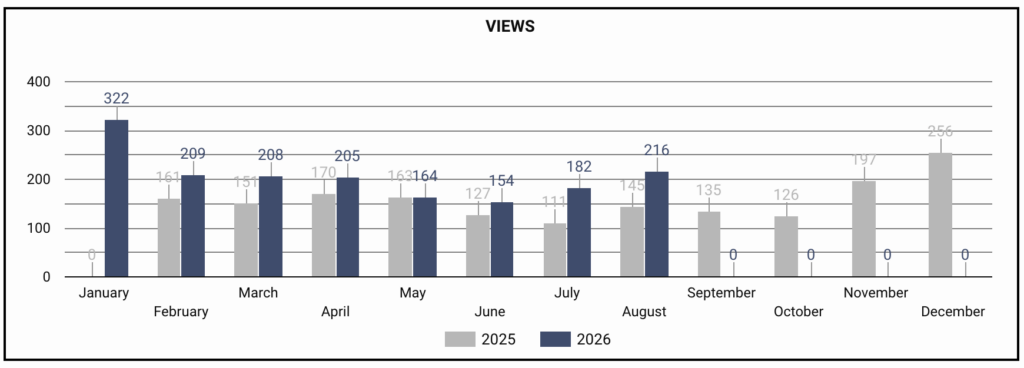
The reporting identifies this data as 100% organic.
Profile views fluctuated throughout 2026: 322 in January, 209 in February, 208 in March, 205 in April, 164 in May, 154 in June, 182 in July and 216 in August.
More interestingly, website clicks from the profile increased from 7 in February to 13 in July and 19 in August.
Again, there isn’t a perfectly straight upward line.
Real marketing rarely has one.
But these metrics help demonstrate something broader: customers weren’t encountering the company in only one place anymore.
They could find the website through traditional Google search.
They could encounter the Google Business Profile.
They could see social content.
They could see branded company vehicles.
They could encounter sponsorships in the community.
They could hear the name from someone they trusted.
And all of those touchpoints began looking and sounding like the same business.
SEO Wasn't Finished When the Website Launched
One of the biggest misconceptions surrounding SEO is that it’s something you “do” to a website and then cross off the list.
It isn’t.
Search behavior changes. Competitors change. Google’s results change. New services become priorities. Customers ask new questions. Reviews accumulate. Projects provide stronger examples. And now AI-powered search platforms are adding another layer to the way people research and evaluate businesses.
That means our work today doesn’t look exactly like it did when the website launched.
We continue evaluating search performance, identifying content opportunities, expanding useful pages and strengthening the signals that help both traditional search engines and newer AI platforms understand the business.
That’s also why Plaski now approaches AI Marketing and Answer Engine Optimization alongside traditional SEO. Clear service information, structured content, accurate business information, helpful FAQs, demonstrated expertise and a strong broader digital presence all make it easier for search engines and AI systems to understand what a company offers.
The question isn’t simply:
“Are we ranking?”
It’s also:
What are customers searching for now? Where are we already winning? Where are competitors outranking us? What questions haven’t we answered yet? Which services or locations should we strengthen next? And how is search itself changing?
That chase doesn’t really end.
And that’s okay.
Eventually, Paid Advertising Became the Next Step. Not the First One.
Here’s another piece of the timeline that matters: Google Ads didn’t begin until August 2026.
By then, the new brand and website had already been live for roughly five months.
The business had already moved through much of its busy season.
The website was already attracting considerably more traffic than it had before launch.
Organic Google visibility, reviews, referrals, social content, branded vehicles and community recognition were already contributing to the larger ecosystem.
In August, the brand-new Google Ads campaign recorded 168 impressions and 14 clicks.
That’s useful context because it makes it impossible to attribute the entire spring and summer increase to paid search.
Paid advertising came after the foundation.
Now Plaski’s Paid Media services and more specifically Google Ads management can complement the organic visibility that already exists instead of being asked to compensate for an unclear brand or underperforming website.
That’s a very different strategy from throwing money at ads on day one and hoping everything else sorts itself out later.
So What Actually Changed?
There isn’t one metric that tells this entire story because there wasn’t one change responsible for the growth.
A recognizable visual identity replaced inconsistent branding. A custom website replaced a basic online presence that had attracted just 16 users the month before launch. SEO gave search engines more useful information about the company’s services and market. Project photography made the work easier to evaluate. Reviews and Google visibility strengthened the company’s local footprint. Social media created repeated brand touchpoints. Vehicles and sponsorships took that same identity into the real world. Paid advertising was added only later, once the business was ready for another layer of demand.
And underneath all of it was something equally important:
The strategy was allowed to grow with the company.
We didn’t try to turn a three-person operation into a 30-person company overnight.
We helped make the business they already had more visible, recognizable and competitive, then continued building from there.
The Website Wasn't Responsible for Everything. Neither Was SEO. Neither Was the Logo.
This may be the most important lesson in the entire case study.
Marketing attribution gets messy in the real world.
Someone might see a wrapped truck on Tuesday.
Two weeks later, they notice the company sponsoring something locally.
A friend mentions the name.
They Google it.
They read a review.
They visit the website.
They look through project photos.
They leave.
Three days later, they search for the service again, recognize the company and finally request an estimate.
So what generated that lead?
The truck?
The sponsorship?
The referral?
The brand?
Google?
The website?
SEO?
Social media?
The review?
Probably some combination of them.
That’s the point.
Strong marketing isn’t one magic channel.
It’s creating enough consistent, credible touchpoints that when a customer is finally ready to make a decision, your business is familiar, findable and easy to trust.
Your Business Might Not Need "More Marketing." It Might Need a Better Foundation.
If you’re reading this because you already have a website but can’t understand why nobody seems to find it, you’re not alone.
If your logo exists but every piece of marketing looks slightly different, you’re not alone either.
And if you know you need marketing but you’re worried about generating more work than your team can actually handle, that’s a legitimate concern.
The answer isn’t necessarily doing everything at once.
A good marketing strategy should consider where your business is today, where you want it to go, how quickly you actually want to get there and what your budget can reasonably support.
At Plaski Advertising, our broader marketing solutions connect branding, websites, SEO, AI search, social media, photography and paid media based on what actually makes sense for the business. That’s consistent with how Plaski currently describes its full-service approach: each piece affects the others, and strategy determines what should happen next.
Because sustainable growth isn’t about checking every marketing box.
It’s about putting the right pieces together in the right order.
Frequently Asked Questions
Having a website does not guarantee organic search visibility. Search engines need enough information and signals to understand what your business does, where you operate and why your site is relevant to a particular search. Website structure, content, local relevance, reviews, competition, technical performance and the broader digital footprint surrounding the business can all play a role.
For businesses throughout Franklin, Greenwood, Bargersville, Trafalgar and the surrounding area, Plaski also focuses on hyper-local Johnson County marketing rather than treating every Central Indiana search market as interchangeable.
There isn’t a universal percentage.
In this case, website users increased from 16 in February to 163 in March, the month the new website launched. Traffic then fluctuated between 115 and 153 users through the spring and early summer before reaching 227 users in August.
That does not mean every new website will produce the same result, nor does it mean the website alone caused the growth. The brand, content, SEO, business maturity and other marketing activity were developing alongside it.
Not always.
Some existing websites can be significantly improved through content, technical SEO, internal linking, local optimization and structural changes. Others have platform, usability or content limitations that make rebuilding the website more practical than continuously working around them.
The right answer depends on what is actually limiting performance.
Yes, particularly when customers may encounter the business several times before making contact.
Branding isn’t just a logo. It includes the visual and verbal cues that help the same company feel recognizable across a website, social media account, work vehicle, sponsorship, shirt, estimate or advertisement.
Recognition can’t guarantee a sale, but inconsistency makes recognition much harder.
There is no universal timeline.
Competition, geography, website history, content, authority, reviews and the current state of the business’s digital presence all influence how quickly results develop.
That’s why we treat SEO as an ongoing strategy rather than a one-time task completed during a website build.
SEO focuses largely on helping webpages become discoverable and competitive within traditional search results.
Answer Engine Optimization, or AEO, also considers whether AI-powered search systems can clearly understand, summarize, cite or potentially recommend information about the business.
The strategies overlap heavily. Strong website structure, useful content, accurate information, demonstrated expertise and trustworthy external signals can support both. Plaski explains that approach more fully in its AI Marketing and AI Search Optimization resources
Not necessarily.
Paid advertising can provide valuable visibility quickly, but its timing should depend on the company’s goals, budget, website, capacity and existing marketing foundation.
In this case, Google Ads weren’t introduced until August, months after the website launch. That sequencing allowed paid search to become an additional growth tool rather than the only thing making the business visible.
Absolutely.
Generating demand the business cannot fulfill can create longer wait times, slower responses and frustrated potential customers. Lead volume needs to be considered alongside staffing, scheduling, margins and growth goals.
Good marketing asks more than, “How many leads can we create?”
It also asks, “How much growth is this business actually ready for?”
Build a Marketing Strategy That Fits the Business You're Actually Running
You don’t need every marketing service tomorrow.
You need to understand which investment makes sense next.
Maybe that’s building a recognizable brand.
Maybe it’s replacing a website that’s technically online but barely being found.
Maybe it’s strengthening your local Google presence, publishing content around the questions your customers are already asking, preparing for AI search, developing better project photography or adding paid advertising when you’re ready for additional demand.
The right order will look different for every business.
That’s how we approach marketing at Plaski. We don’t just ask how many leads we can generate. We ask what kind of growth your business is actually ready for.